

How Berwick is shaping its energy future
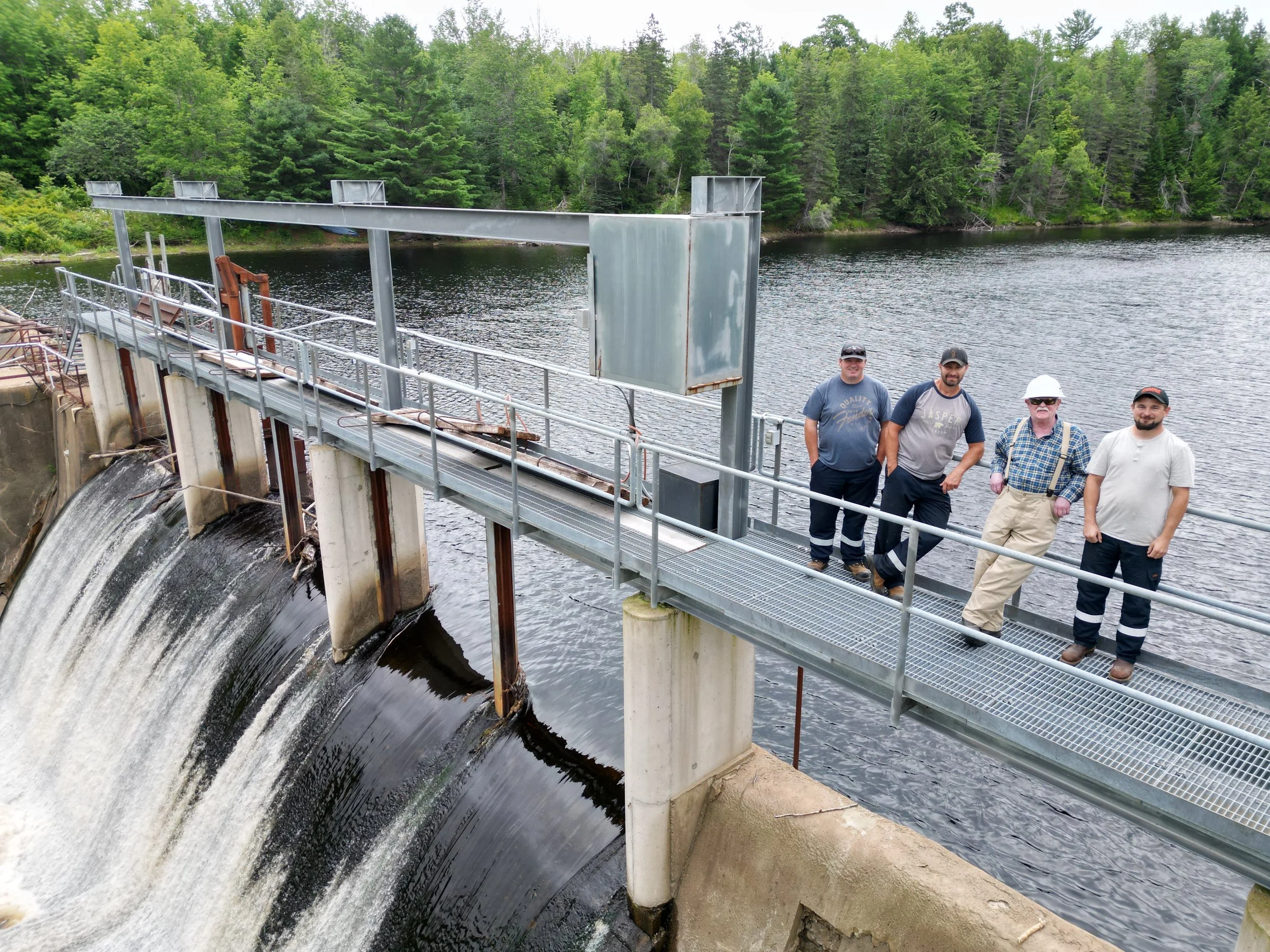
Since 1921, the Berwick Electric Commission has generated its own power – first from hydro, and more recently from wind and solar too. Now it's working with the Maritime Municipal Electric Utility Alliance to meet the energy challenges ahead.
By Jen Boyd
When the power goes out in Berwick, people notice how fast it comes back on. That's not an accident – it's what a community-owned utility is supposed to deliver.
The Berwick Electric Commission has been doing exactly that for more than a century.
Our utility dates back to 1921, when the community began operating a hydroelectric generating system on the South Branch Annapolis River, two years before our town was officially incorporated.
That dam is also where our renewable energy story starts – and it's grown a lot since.
Our community – known as Nova Scotia’s Apple Capital – has about 2,500 residents in the heart of the Annapolis Valley. About 90 minutes northwest of Halifax, we’re nestled along the Cornwallis River, traditionally known to the Mi’kmaq as Jijuktu’kwejk (“The Narrow River”).
Our municipally-run utility operates the distribution system that serves the town and some adjacent areas of Kings County. We have about 1,700 customers. About 90 per cent are residential and the rest are commercial and industrial. We are proud that more than 50 per cent of the town’s power comes from renewable sources and will go higher when our hydroelectric dam comes back on line.
What sets our utility apart is the fast and efficient service we provide customers, from restoring power after an outage to hook-ups and inspections.
Our small size is our strength
The utility has four full-time staff. Adam King joined as the commission’s director of electric services in May after almost 20 years with Nova Scotia Power. He oversees three full-time power line technicians and a part-time electrical inspector. Town staff provide the administrative functions.
Our small size is our strength. We pride ourselves on our municipal ownership and community ties. Yet the energy market is complex, from new technology to new regulations. That’s why we value our partnership in the Maritime Municipal Electric Utility Alliance (MMEUA).
For us in Berwick, the Alliance is about capacity building, learning and leaning on other municipal utilities across the Maritimes to better serve our communities.
The Alliance brings together municipally owned utilities in New Brunswick, Nova Scotia and Prince Edward Island. Each utility remains independent, but by working together we share expertise, lessons learned and identify opportunities that would be more difficult to pursue on our own.
For us in Berwick, the Alliance is about capacity building, learning and leaning on other municipal utilities across the Maritimes to better serve our communities.
Adam and I have seen firsthand how the Alliance has benefitted Berwick and its customers. For example, we relied on expertise from MMEUA member Saint John Energy for our smart meters project.
Strength in the Alliance
The Alliance has also made us more aware of the different regulatory regimes across the Maritimes. That’s one challenge that confronts small utilities, and one that the MMEUA really helps with. Regulations are typically written with large utilities in mind, putting a burden on municipal utilities with fewer staff and smaller budgets.
Adam notes that the collective might of the Alliance is a real strength.
“When you've got six or seven municipal utilities in the room, each bringing something different – regulatory know-how, business planning, the technical side – that's a voice that carries far more weight than any one of us alone.”
Our commitment to community and renewable energy is the legacy of Don Regan, who spent more than four decades working in Berwick, starting as a powerline technician before becoming superintendent of the utility in 1983 and then Chief Administrative Officer of the town.
He was a strong advocate for municipally owned utilities and a catalyst for collaboration with colleagues across the province. He helped create the Alternative Resource Energy Authority, a renewable energy company jointly owned by the towns of Mahone Bay, Antigonish and Berwick.
That company developed the Ellershouse Wind Farm and community solar gardens which supply power to the three communities. The projects are a testament to the ability of municipal utilities to be nimble and innovative.
The 10-turbine, 23.5-megawatt wind farm was completed in 2018. This allowed Berwick to meet the goal of 40 per cent renewable energy two years ahead of a provincial deadline. Our next target is 80 per cent renewable by 2030.
Berwick’s solar farm, spanning six hectares, can produce 4.8 megawatts of electricity, about 14 per cent of the town’s energy demands.
The Factorydale dam – which in its early days provided all of the town’s electrical needs – has been offline for refurbishment. That’s one of the challenges in operating a 100-year-old plus piece of infrastructure. We have a project scoped that would see the generator, turbine, and controls upgraded to today's construction standards, and increase the electricity it can produce.
Today, Berwick is preparing for growth. The town, largely single-family homes, is looking to add density with townhouses and apartments.
Helping spur that growth is the federal investment in Canadian Forces Base Greenwood – the largest air force base on the east coast – which could create upwards of 600 jobs. We expect that Berwick, just 20 minutes from the base, will be an attractive housing choice for the new employees and their families.
The Berwick Electric Commission will be ready. We are committed to a future rooted in the tradition of the past – green and community focused.

Jen Boyd is the Chief Administrative Officer for the Town of Berwick.